
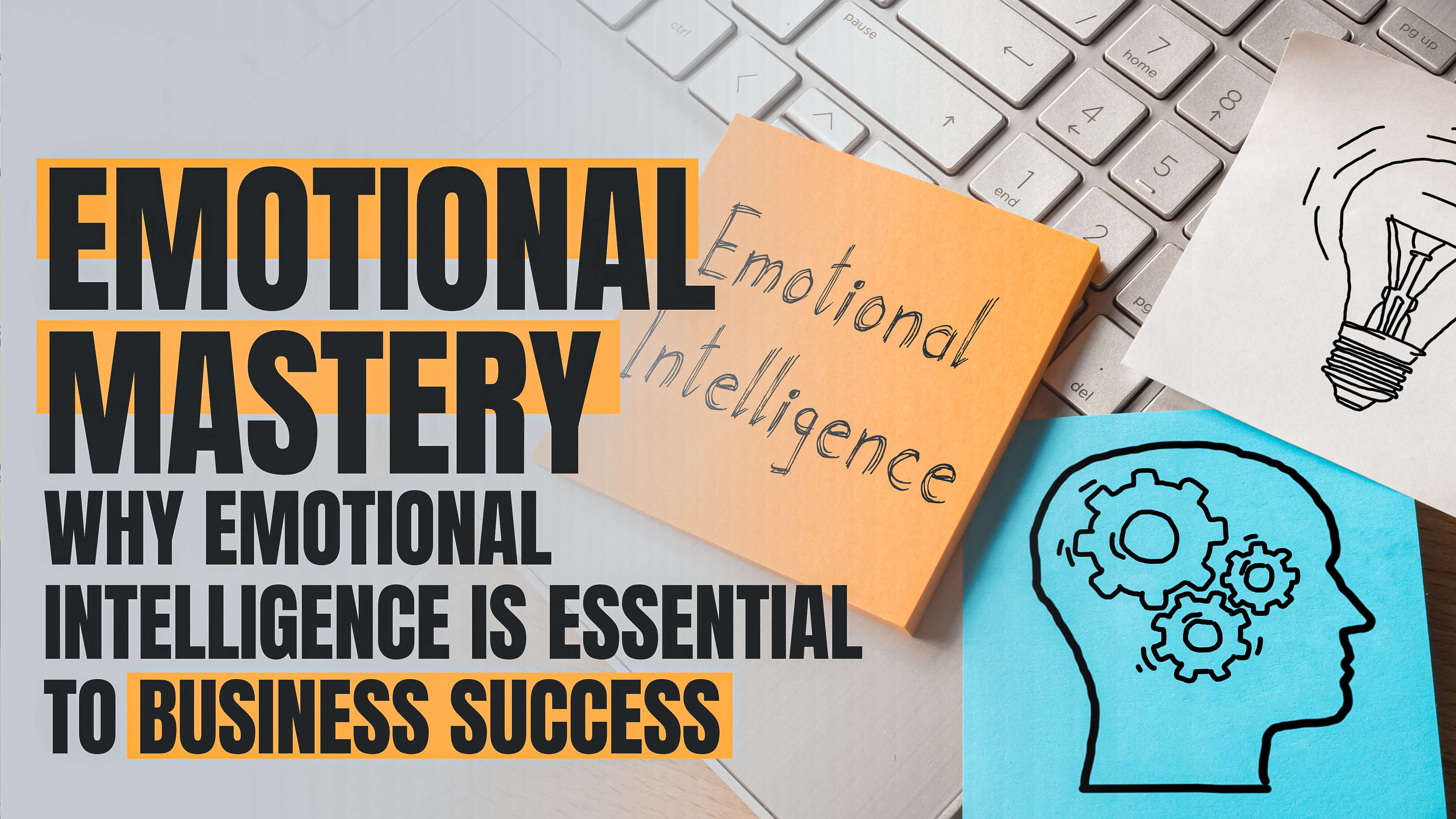

Why Emotional Intelligence Is Essential to Business Success
For a long time, I believed business success came down to logic.
Strategy. Execution. Discipline. Systems.
Those things matter — a lot. But they don’t tell the full story.
What I’ve learned, both as an athlete and as an entrepreneur, is this:
Pressure doesn’t test strategy. It tests emotion.
And business is nothing but pressure.
That’s what drew me to Emotional Mastery. Not from a self-help angle, but from a performance one. I wanted to understand why some leaders stay clear when everything feels unstable — while others implode, even with great plans in place.
The Emotional Reality Nobody Talks About
In American business culture, emotion is often treated like a liability.
We praise “rational decision-making.”
We talk about “leaving emotions at the door.”
But that idea collapses the moment reality hits.
Emotions show up when:
- A deal is about to fall apart
- Revenue drops unexpectedly
- A key employee resigns
- A competitor outpaces you
- Public criticism lands harder than expected
You don’t get to opt out of emotion.
You only get to decide whether you manage it — or let it manage you.
And most leaders don’t realize they’re being driven by emotion because it’s disguised as logic.
Emotional Intelligence Is Not Soft — It’s Structural
One of the biggest myths around emotional intelligence is that it’s about being “nice.”
It’s not.
It’s about awareness under pressure.
Consider Jeff Bezos in Amazon’s early years. Internally, Amazon was known for intense standards and difficult conversations. But Bezos was also known for staying unusually calm during volatility — including during the dot-com crash, when Amazon’s stock dropped over 90%.
Many companies with strong ideas didn’t survive that era.
Amazon did — not because the business model was perfect, but because leadership didn’t panic and abandon long-term thinking.
That’s emotional intelligence in action.
High IQ Isn’t Enough
Some of the smartest people fail in business.
Not because they lack skill — but because they lack emotional regulation.
We’ve seen this repeatedly in Silicon Valley: technically brilliant founders who struggle with conflict, feedback, or control.
Travis Kalanick helped build Uber into a global giant — but emotional volatility, public confrontations, and internal culture issues eventually forced leadership change. The business survived, but only after emotional leadership became a priority.
Skill builds opportunity.
Emotional maturity determines longevity.
Emotional Mastery Creates Leverage
When leaders develop emotional intelligence, something interesting happens:
- Teams trust them more
- Conflict resolves faster
- Decision-making improves
- Culture stabilizes
- Growth becomes sustainable
Look at Satya Nadella’s transformation of Microsoft.
When he became CEO, Microsoft wasn’t failing — but it was stagnant. One of Nadella’s biggest shifts wasn’t technical. It was cultural.
He emphasized empathy, listening, and learning — not as slogans, but as leadership behavior. The result wasn’t softness. It was renewed innovation, stronger teams, and massive growth.
Emotion didn’t weaken the business.
It unlocked it.
The Athletic Parallel Still Applies
In sports, talent alone doesn’t win championships.
Athletes train emotional discipline because performance collapses when emotions spike uncontrollably.
Business is no different.
You can have:
- Capital
- Systems
- Advisors
- Strategy
But if you panic under uncertainty, avoid hard conversations, or react defensively to feedback — performance drops.
Emotional mastery is what keeps leaders steady when momentum shifts.
The Real Cost of Emotional Immaturity
When emotional intelligence is missing, the damage is subtle at first — then expensive.
It shows up as:
- High employee turnover
- Broken partnerships
- Missed opportunities
- Founder burnout
- Decision paralysis
Many startups don’t fail because the idea was bad.
They fail because leadership couldn’t manage pressure, ego, or fear at scale.
Emotional Intelligence Is a Business Skill
Emotional Mastery reinforced something I already suspected:
The inner game is not separate from the outer game.
Your business can only grow to the level your emotional habits allow.
If success makes you anxious, you’ll unconsciously cap growth.
If conflict terrifies you, you’ll avoid leadership moments.
If criticism triggers you, progress slows.
Emotional mastery doesn’t make business easier.
It makes you stronger inside the difficulty.
Why This Matters Right Now
Today’s environment is fast, public, and unforgiving.
Mistakes are visible.
Feedback is instant.
Pressure is constant.
The leaders who last aren’t the loudest or the most aggressive.
They’re the most regulated.
They think clearly when others react.
They stay composed when others spiral.
They play long-term games in short-term chaos.
That’s not luck.
That’s emotional discipline.
Final Thought
Business mastery doesn’t start with tactics.
It starts with the ability to stay grounded when things don’t go your way.
If the intention is to construct a durable, large-scale, and significant thing — then emotional intelligence is a must.
It’s foundational.
Because when your emotions are trained, your decisions get better.
And when decisions get better, everything else follows.