


What We Lost on May 2, 2026
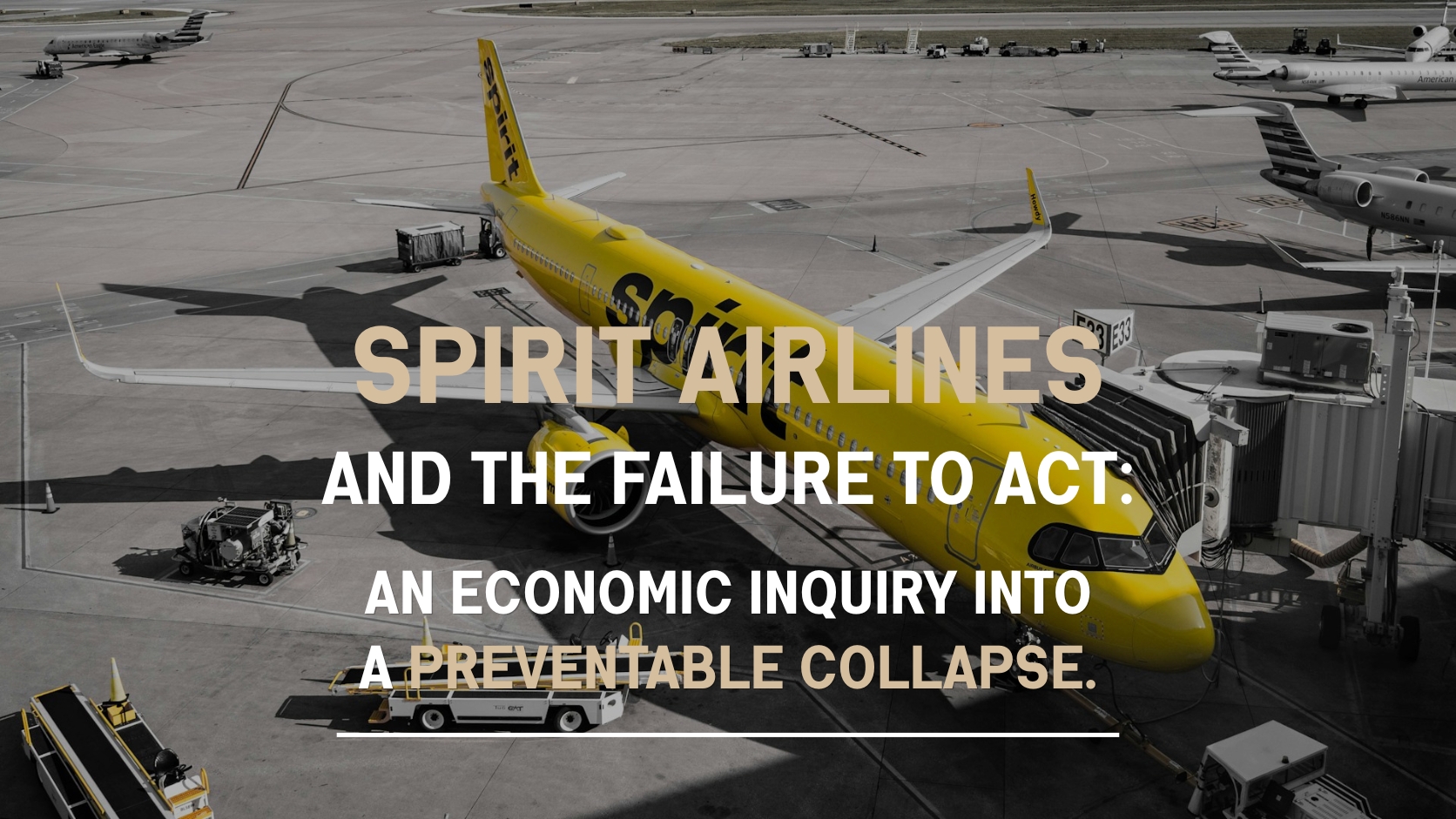
On May 2, 2026, Spirit Airlines ceased all operations. No gradual wind-down. No transition plan. The airline simply stopped. Seventeen thousand employees lost their jobs overnight. Thousands of passengers were stranded at airports across the country, some learning at the curb that their flights no longer existed. Within hours, the booking page was replaced with a single message: “Spirit is winding down all operations.”
This was the eighth-largest airline in the United States. A carrier that served millions of passengers annually across domestic routes, Latin America, and the Caribbean. A company that employed over 3,000 people in South Florida alone and anchored nearly 29% of Fort Lauderdale-Hollywood International Airport’s total passenger capacity. And it vanished in a single night.
I have close ties to the airline industry. I’ve spent time around flight crews, observed the daily realities of airline operations from the inside, and watched this story unfold in real time, not from a newsroom but from a front-row seat. That proximity is part of why I’m writing this. But more importantly, I’ve spent enough time studying markets, businesses, and the patterns behind both to recognize when a collapse was preventable. And this one was.
Before I get into the business analysis, the regulatory decisions, the leadership challenges, and the broader economic implications of this collapse, I want to share something that rarely makes it into these conversations: what the people behind an airline actually go through every day.
Most people have no idea what a flight attendant’s day actually looks like. The alarm goes off before 4 AM. Meals are prepped the night before because airport food isn’t practical on a flight attendant’s schedule or pay. They arrive in uniform, badge on, and ready to work while most of the world is still asleep. They check in, receive their assignment, and board. Then they fly.
Three flights before a layover is a normal day. Miami to Houston. Houston to Nashville. Nashville to Chicago. Hours of unpaid boarding time before any of it even begins. And throughout all of it, they are managing safety protocols, medical situations, difficult passengers, and the quiet, grinding reality of a job that most people fundamentally underestimate.
Flight attendants are not waitresses in the sky. They are federally certified safety professionals who also happen to serve you a ginger ale. And they do it with a level of consistency and composure that would challenge most professionals in any industry.
I share this because it matters to the story. The people most affected by Spirit’s collapse aren’t abstractions. They are skilled professionals who showed up every single day and gave everything to a company that, in the end, couldn’t hold itself together around them. Seventeen thousand of them deserve more than a headline. They deserve an honest accounting of what went wrong.
What happened to Spirit wasn’t inevitable. It was the result of a series of decisions, regulatory, executive, and systemic, that compounded over time and ultimately cost those seventeen thousand people their livelihoods. I think we owe it to them to understand what actually went wrong, and what it means for the rest of us.
Spirit Airlines: America’s Real Airline
Let’s take a closer look at what Spirit Airlines actually meant, both to its customer base and to the airline industry as a whole, because that context is essential to understanding the full weight of this collapse.
Spirit wasn’t just a budget carrier. Spirit wasn’t a punchline. Spirit was the airline where affordability made the difference. Full stop. That is not a small thing. That is a transformational contribution to American mobility, economic participation, and quality of life.
Think about what Spirit did. They looked at an industry dominated by legacy carriers charging premium prices for a commodity product, getting a human body from Point A to Point B, and said: we can do this for less. They stripped out the frills. They unbundled the fare. They let passengers choose what they wanted to pay for and what they didn’t. And in doing so, they opened the skies to families, students, hourly workers, immigrants visiting relatives abroad, and countless others who had been priced out of air travel entirely.
Spirit is THE spirit of the airline industry. They didn’t just compete with the Big Four. They forced the Big Four to change. Every time you see a “basic economy” fare on Delta, United, or American, you’re looking at Spirit’s influence. The legacy carriers didn’t create those products out of innovation. They created them because Spirit was eating their lunch on price, and they had to respond. That’s not the mark of a failing company. That’s the mark of a company that reshaped an entire industry.
Let me make this concrete. Go right now and search for a one-way flight from Fort Lauderdale to LaGuardia. As I write this, American Airlines is showing that route at $444 with a travel time exceeding fourteen hours: layovers, connections, the works. United? Over $1,000 for a nineteen-hour odyssey. Now ask yourself: what did Spirit charge for that same flight? You already know the answer. You could fly direct, nonstop, for a fraction of those prices. Often under $80.
That pricing power didn’t just serve budget travelers. It disciplined the entire market. When Spirit had a certain route, fares dropped across the board. Historical data consistently shows that when ultra-low-cost carriers exit a market, fares on those routes jump dramatically, with some estimates suggesting increases of 70% or more. Without Spirit, air travel prices will surge, and the market will prove just how “competitive” it really is. Don’t take my word for it. Watch the fares. They’re already climbing.
And it’s not just domestic. Spirit connected Americans to Latin America and the Caribbean at price points that made international travel accessible to working-class families. Visiting relatives in Colombia, the Dominican Republic, Puerto Rico, Jamaica: Spirit made those trips possible. That connectivity is now gone, and nobody in the legacy space is rushing to replace it at those price points.
Then there’s the local devastation. Spirit moved its headquarters from Detroit to Broward County in 1999. It built an enormous corporate campus in Dania Beach: a six-story office building, a technical center with flight simulators, employee housing, and a nearly 1,000-space parking garage. That campus represented over $170 million in capital investment. Spirit was responsible for roughly 29% of Fort Lauderdale-Hollywood International Airport’s total passenger capacity. They employed over 3,000 people in South Florida alone at their peak. Broward County didn’t just lose an airline. It lost a pillar of its economic identity.
This was not a company that deserved to die quietly while people made jokes about legroom.
The JetBlue Merger: A Case Study in Regulatory Outcomes
This section of the story deserves careful attention, because the sequence of events that followed the merger decision should prompt serious reflection from policymakers and regulators alike.
In July 2022, JetBlue offered $3.8 billion in cash to acquire Spirit Airlines. Shareholders voted yes. The flight attendants’ union supported it. The companies believed, and argued publicly, that a combined carrier would create the nation’s fifth-largest airline, capable of genuinely competing with the Big Four: American, Delta, United, and Southwest. The combined entity would have held roughly 9% of the U.S. market. Not dominant. Not monopolistic. Nine percent.
The Department of Justice filed suit to block the merger, and a federal judge sided with the DOJ in January 2024. The stated rationale was that the merger would harm consumers by eliminating a low-cost competitor.
Looking back with the full picture in front of us, it’s difficult not to question whether blocking the JetBlue-Spirit merger was the right call. And the evidence supporting that question is now impossible to ignore.
The government’s argument rested on the idea that eliminating Spirit as an independent ultra-low-cost carrier would reduce competition and raise fares. The judge wrote that allowing JetBlue to absorb Spirit would violate core antitrust principles. Former Attorney General Merrick Garland called it a victory for consumers.
But here’s what actually happened: Spirit, unable to survive independently after the merger collapse, filed for Chapter 11 bankruptcy in November 2024. It emerged briefly, only to file again in August 2025. And now, in May 2026, it’s gone. Seventeen thousand jobs evaporated. The ultra-low-cost competitor that the DOJ was protecting no longer exists. The cheap fares the government claimed to be preserving are gone.
The regulatory action that was designed to protect competition ultimately eliminated the competitor. That is not spin. That is the factual outcome. And it raises questions worth examining seriously.
Consider the broader context. American Airlines merged with US Airways in 2013, creating the world’s largest airline. United merged with Continental in 2010. Delta merged with Northwest in 2008. These were massive consolidations that arguably created far more market concentration than a JetBlue-Spirit combination ever would have. And they were all approved. Those mergers didn’t create a fifth challenger to the dominant carriers. They further entrenched the dominance of the existing giants. Yet a deal that would have created a new, meaningful competitor to those same giants was blocked.
That inconsistency is worth examining on its merits.
Think about what the merger could have been. JetBlue, with its brand reputation for premium in-flight experience, could have operated as the higher-tier, coast-to-coast carrier. Spirit, with its massive fleet of newer Airbus aircraft and its unmatched route network across mid-market and underserved cities, could have functioned as a regionally focused, high-frequency commuter airline beneath the JetBlue umbrella. Vertical alignment. Shared maintenance infrastructure. Streamlined operations. Better resource allocation. Cost efficiencies that neither airline could achieve alone.
Spirit’s fleet was one of the youngest in the industry. Their route coverage touched cities that the Big Four ignored. In the merger context, Spirit wasn’t a liability. Spirit was a unicorn. No other carrier was positioned to provide that combination of assets to a mid-size acquirer. The JetBlue-Spirit deal wasn’t anti-competitive. It was pro-competitive. It was market stimulation. It was calling on the dominant players to rise to the occasion. That’s exactly how healthy markets are supposed to work.
Instead, the merger was blocked. And now look at the results. Spirit Airlines is gone. JetBlue itself is financially fragile. And the Big Four are absorbing Spirit’s market share without lifting a finger. American Airlines is already advertising discounted fares on former Spirit routes. They didn’t earn that market share through innovation. They inherited it as a consequence of a regulatory decision that removed their most disruptive competitor from the board.
It’s reasonable to ask who ultimately benefited from this outcome. Not the consumers, who are facing higher fares. Not the workers, seventeen thousand of whom just lost their jobs. Not the traveling public, who lost an entire airline overnight. The entities that gained the most are the incumbents: the Big Four, the carriers with the deepest lobbying presence in Washington.
I want to be measured here, because this is a space where precision matters. I’m not alleging wrongdoing. But I do believe that when the outcome of a regulatory decision so clearly aligns with the interests of the most powerful incumbents in an industry known for its lobbying activity, it warrants a transparent and thorough review. The airline industry spends tens of millions of dollars annually on lobbying. That is public record. And the result of this specific decision was the removal of a competitor that those incumbents had every reason to want gone.
That warrants scrutiny. Not accusations, but scrutiny. I’m intrigued by the decision-making process that led regulators to conclude that blocking this merger was in the public interest. Because the public is worse off today by every measurable standard.
Even Transportation Secretary Sean Duffy, in the aftermath of Spirit’s shutdown, publicly questioned the wisdom of the decision, suggesting it ultimately worked against the interests of consumers and aviation workers.
This decision is something to be looked at. Not as political theater, but as genuine regulatory accountability.
Leadership Questions: Executive Stewardship Under Scrutiny
Regulatory outcomes don’t explain everything. Spirit’s executive leadership also warrants examination for the condition the airline was in when it most needed steady hands at the wheel.
Ted Christie served as Spirit’s CEO from January 2019 to April 2025, the most turbulent and consequential period in the company’s history. He navigated COVID. He oversaw the merger attempts with both Frontier and JetBlue. He was at the helm during both bankruptcy filings. And when it was over, he stepped down and transitioned to a board seat at Encompass Health Corporation, one of the nation’s largest healthcare companies.
A question worth raising: how does the CEO of a company in financial distress take on a board seat at another major public corporation? Christie was appointed to the Encompass Health board in late 2023, while Spirit was hemorrhaging cash, facing existential competitive pressures, and moving toward bankruptcy. Serving on a public company board is not a casual commitment. It requires time, attention, and fiduciary responsibility. Meanwhile, Spirit’s shareholders were watching their equity evaporate and Spirit’s employees were watching their futures grow increasingly uncertain.
Whether Christie’s attention was divided is a fair question, not an accusation, but a question that stakeholders deserve to have answered.
Then there’s the compensation structure. During a period in which Spirit lost more than $2.5 billion, cut thousands of jobs, sold aircraft to generate emergency cash, and filed for bankruptcy twice, the executive suite continued to be compensated at levels that invite scrutiny. The broader pattern is worth noting: when executive compensation is disconnected from company performance, it raises legitimate governance concerns. Spirit’s leadership presided over the erosion of the company’s value, and yet the financial consequences of that erosion were borne disproportionately by employees and shareholders.
Then there was the strategic direction, or the apparent lack of one. Selling aircraft while trying to operate an airline raises an obvious question: are you an airline or an airplane dealer? I expect that the aircraft that were sold didn’t affect anything logistically. Yet, are we sure that every plane that left Spirit’s fleet was a route that couldn’t be flown, a revenue stream that couldn’t be captured, and a signal to the market that the company was contracting rather than competing. The only reason I ask is due to the timing of the staff scheduling issues shortly after liquidating planes became a tactic.
Leadership communication in the company’s final months reportedly conveyed a tone of resignation: the forces against us are too strong, we’re doing our best. That may have been honest. But honesty without a credible path forward has consequences. When leadership signals that the fight is over, the organization tends to stop fighting. Morale eroded, and with it went whatever operational momentum remained.
Spirit’s executive management seems a bit disjointed for how they stewarded this company during its most critical period. And the broader business community should take note: this is what it looks like when corporate governance falls short at the moment it matters most.
The $500 Million Question: Why Didn’t Anyone Save Spirit?
This is the question that stays with me, because the business case for saving Spirit Airlines is staring us all in the face.
When Spirit filed for its second bankruptcy in August 2025, it reported $8.1 billion in debts against $8.6 billion in assets. Yes, the debt picture was serious. But let’s put this in perspective, because the narrative that Spirit was “too far gone” to save contradicts decades of corporate history.
Since when does a company need to be profitable to be worth saving?
Consider a few well-known examples that the business world seems to have set aside.
Marvel Entertainment was functionally bankrupt in the late 1990s. The comic book market had collapsed. The company was buried in debt, its intellectual property fragmented across bad licensing deals. In 2009, Disney acquired Marvel for $4 billion. Today, the Marvel Cinematic Universe has generated over $30 billion in box office revenue alone, not counting theme parks, merchandise, and streaming content. Someone saw value where others saw wreckage.
Apple in 1997 was ninety days from insolvency. The company was losing market share, burning cash, and considered irrelevant by most of the tech industry. Then Steve Jobs returned, Microsoft invested $150 million, and Apple embarked on the most extraordinary corporate turnaround in modern history. Today it’s the most valuable company on earth.
Continental Airlines filed for bankruptcy twice, in 1983 and 1990. It was considered the worst airline in America. Gordon Bethune took over as CEO in 1994 and executed one of the most celebrated turnarounds in aviation history, transforming Continental into a profitable, award-winning carrier that eventually merged with United from a position of strength.
Chrysler was bailed out by the federal government in 1979 with $1.5 billion in loan guarantees. Lee Iacocca restructured the company, launched the minivan, and not only repaid the loans early but turned Chrysler into one of America’s most profitable automakers for the next decade.
These are not obscure examples. These are foundational case studies taught in every business school in the country. The lesson is consistent: distressed companies with real assets, real market positions, and real brand recognition can be turned around, if someone with vision and capital steps up.
Spirit had real assets. Its fleet, while partially sold off, still included some of the newest narrow-body aircraft in the U.S. market. Its route network covered cities that no other carrier served at those price points. Its brand, despite the jokes, had deep recognition and genuine loyalty among the demographic it served. Its operational infrastructure, including gates, slots, ground handling contracts, and trained crew, represented decades of accumulated capability.
So where was private equity? The turnaround playbook for Spirit practically writes itself. Acquire the carrier out of bankruptcy at a steep discount. Install operators with aggressive restructuring experience. Renegotiate labor contracts with unions that are motivated to preserve jobs. Rationalize the route network around the highest-margin corridors. Partner with, or be acquired by, an entity with fuel cost advantages, perhaps someone with energy industry connections who could hedge fuel exposure more effectively than any standalone airline.
Consider the possibility that a government-facilitated operational takeover could have worked. The Trump administration reportedly explored a bailout that would have given the government a 90% stake. That’s not unprecedented. It echoes the Chrysler model, and it mirrors what governments around the world do with critical transportation infrastructure. Stabilize it, install a competent private operator, and when fuel prices eventually decline, the upside flows directly to profitability and can be returned to taxpayers.
But creditors, including major hedge funds, balked. The deal collapsed. And Spirit went dark.
Is Spirit truly beyond saving, or did the parties in a position to preserve it simply choose not to? And if they chose not to, the follow-up question matters: why? Was it because the turnaround math genuinely didn’t work? Or was it because certain creditors calculated they’d extract more value through liquidation than through preservation? Was it because incumbent carriers, who stand to absorb Spirit’s routes, gates, and market share, had no incentive to see a competitor resurrected?
These are not rhetorical questions. They deserve real answers. And the silence from the investment community so far has been notable.
The Macro View: What Spirit’s Collapse Says About America’s Economy
Zoom out for a moment.
An airline, a piece of critical national transportation infrastructure, collapsed overnight in the United States in 2026. Seventeen thousand people lost their jobs with essentially no notice. Thousands of passengers were stranded at airports across the country. And within hours, the dominant carriers were already moving to absorb the capacity, at higher prices.
If this can happen to an airline, what does that tell us about the resilience of the broader economy?
Everything is getting more expensive. Housing. Healthcare. Education. Food. And now, travel. Air travel is not a luxury for millions of Americans. It’s how they get to work, visit aging parents, attend funerals, make it to job interviews in other cities. The people who relied on Spirit were not leisure travelers choosing between first class and economy. They were people for whom Spirit was the only option. Those people now have no option, or they have options that cost two to three times what they were paying last week.
Corporate America feels it too. I talk to business owners regularly who tell me their travel policies have tightened dramatically. Flights that employees used to book freely now require pre-approval. Travel budgets are being cut. Conferences are going virtual not because companies prefer Zoom, but because they can’t justify the airfare. This is a canary in the coal mine. When businesses start restricting the physical movement of their people, it means the cost structure of the economy has crossed a threshold.
The airline industry is consolidating in a way that will inflict lasting damage on consumers. Spirit Airlines is gone. JetBlue is financially fragile, with its own stock battered and its future uncertain. Frontier is small and lacks the scale to fill the void. What happens when the next one falls? We’re moving toward a market structure where four carriers control essentially all meaningful domestic capacity. That’s not competition. That’s an oligopoly. And oligopolies don’t compete on price. They compete on how efficiently they can extract revenue from a captive customer base.
The Iran conflict and its impact on fuel prices through the Strait of Hormuz crisis accelerated Spirit’s demise, but it didn’t cause it. What caused it was a system, regulatory, financial, and corporate, that allowed a company serving millions of Americans to be slowly squeezed by debt, underserved by its leadership, and ultimately removed from the market through a chain of decisions that, intentional or not, benefited the most powerful players in the industry.
This is bigger than airlines. This is an indicator of where the American economy is headed when competition erodes and consolidation accelerates. When we stop asking whether markets are actually serving consumers and start accepting that the largest players always prevail, we’ve undermined the foundational promise of competitive markets.
A Call to Action
I’m not writing this simply to document what happened. I think something can be done about a situation worth saving.
First: Given that Spirit’s collapse can be traced in part to both a federal regulatory decision and the economic ripple effects of geopolitical conflict, a government-backed intervention deserves serious consideration. These are not partisan issues. The merger was blocked under one administration; fuel costs surged due to foreign policy under another. When both sides of the aisle have contributed to the conditions that brought a major airline to its knees, there is a reasonable case that both sides share a responsibility to help stabilize what’s left. A bailout, structured thoughtfully with taxpayer protections and operational accountability, is not out of the question. It’s been done before, and the precedent exists for exactly this kind of situation.
Liquidation cannot be treated as the default outcome here. Seventeen thousand people are now competing for positions in an already tight labor market, many of them in specialized aviation roles with limited transferability. The question that should be driving every conversation right now is not how to wind this company down, but what can realistically be done to preserve it, restructure it, or transition its workforce and operations into something viable. Liquidation benefits creditors. It does very little for the people who built and operated this airline.
Then: There needs to be a clear-eyed examination of the full chain of events that led to this point: the DOJ’s decision to block the merger, the conduct of the company’s executive leadership during the most critical period in its history, and the broader regulatory and political dynamics that allowed the situation to deteriorate this far. This isn’t about assigning blame to one party or one person. It’s about understanding, with honesty, what the sequence of failures tells us about the health of the airline industry and, more broadly, about what happens to the American economy if more carriers follow this path. If Spirit can collapse like this, who is next, and are we prepared for that?
Also: On a personal note, I want to be part of the solution. I have relationships in private equity and a genuine interest in exploring what it would take to acquire and revive Spirit’s operations. I believe the assets, the brand, and the market demand are still there. And I believe the right group of investors, with the right operational plan, could turn this into one of the great turnaround stories in American aviation. It would be incredible to be a part of that.
Last: None of this should move forward without acknowledging the people who gave the most and received the least. The flight attendants. The pilots. The gate agents. The ramp workers. The mechanics. The reservations agents. The people at Spirit Central in Dania Beach who built that company from a regional carrier into the nation’s eighth-largest airline. They showed up. They did their jobs. They served the traveling public with professionalism, often under impossible conditions. Whatever comes next for Spirit, whether it’s revival, restructuring, or simply a reckoning, these workers deserve to be at the center of the conversation. They deserve better than what they received, and this industry owes them far more than a shrug.
This Is More Than a Business Story
I want to close by returning to the people at the center of this.
Across the country right now, there are thousands of airline professionals sitting with the weight of what just happened. People who gave years of their lives to Spirit Airlines. People who showed up at 4 AM and handled everything the sky threw at them. People who served with composure and professionalism even as the company crumbled around them. They didn’t fail Spirit. The systems around them did.
I refuse to let this become a story that fades in a news cycle. I refuse to let it become another abstract data point about “market forces” and “industry consolidation.” There are real people behind this collapse. People with mortgages, families, and careers that evaporated overnight. They deserve answers. They deserve accountability. And they deserve to know that someone is paying attention.
This is more than a business story. This is a story about what happens when the systems that are supposed to support competition, protect workers, and maintain critical infrastructure fall short at every level simultaneously. And if we don’t learn from it, if we simply move on, then Spirit Airlines won’t be the last preventable collapse.
It will be the first one we chose not to learn from